The phenomena that racially polarized the Detroit area are the same ones that wreaked havoc on race relations across the country for much of the mid to late 20th century — tensions accompanying the civil rights movement, redlining, white flight and growing unemployment. These things segregated neighborhoods and schools in many major metro areas, but all of them hit Detroit especially hard.
Other similarly situated cities were able to somewhat mitigate the effects of segregation in part because they had what the Motor City did not: a viable, comprehensive public transit system. While those regions may have been segregated in terms of housing, at least disparate groups of people still had the ability to travel freely within the region.
But there's been enough time spent lamenting the opportunity lost 50 years ago of building a comprehensive public transit system in Detroit. To their credit, local leaders have begun to realize that even today, Detroit's best bet for a recovery must include some semblance of a light rail mass transit system. The Detroit-Ann Arbor Regional Rail Project, one of several such projects in the works for distant cities in lower Michigan, is a fantastic start. Using existing rail lines, the project will finally link Ann Arbor and Detroit, which will prove mutually beneficial to both cities. For one thing, 45,000 students living in Ann Arbor will finally have an easy way to get to downtown Detroit for concerts, sporting events, etc. Detroit is still a million miles from being a vibrant, livable city, but this little bit of anticipated progress almost brings me to tears.
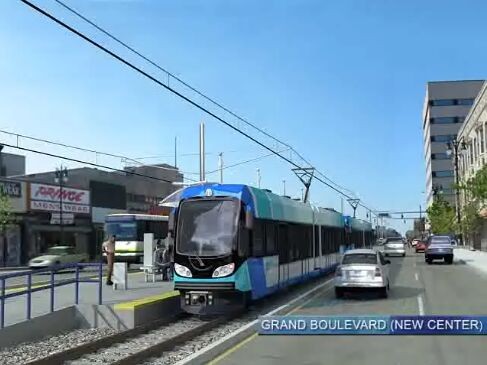 |
| The proposed Woodward Ave. LRT |
Also in the works is the Woodward Ave LRT, a tiny bit of track that will connect downtown Detroit to the New Center Area in its first phase, and then extend out to the edge of Detroit along Woodward Ave. The project does not go nearly far enough, of course: A regional transit system must at least traverse the region. Unless the line extends along Woodward through Ferndale, Royal Oak and Birmingham, its effect on rejuvenating this region will be minimal. Of course, any plan to extend the rail line into Oakland County will face immense opposition, but I have hope that we're moving closer to the day that the suburbs will want to be connected to the core of Detroit.
I laid all that background to get this discussion to SkyTran- a futuristic system of public transit that has been much debated since it was discussed by Free Press Columnist Ron Dzwonkowski last week. SkyTran is marketed as a more efficient, stream-lined, and personal system of mass transit. It uses individualized pods, raised magnetic lines, and scatters more stations in an attempt to be make for as comprehensive a system as possible. Especially in an area that is so disparate and lacks even remote skeletons of existing rails lines that could be used in core areas (the Ann Arbor/Detroit line being a rare exception), SkyTran certain seems like a solution worth exploring.
| A SkyTran pod |
As advertised, SkyTran is less intrusive to the existing infrastructure, won't contribute to traffic backups, is quicker to get up and running, is much more energy efficient and will be more accessible in most areas than traditional light rail. More than that, the costs of implementing SkyTran may actually be pretty close to free. As Dzwonkowski wrote, SkyTran is eager to test its product in a real city, and Detroit is the perfect candidate- so much so that the company will pay most of the costs entailed in getting the system up and running. When compared to the millions of taxpayer dollars the Woodward Ave. LRT would cost, SkyTran certainly seems like an idea worth exploring, right?
I'm not naive; I share with most people a healthy skepticism of anything that is advertised as free. However, in exploring all options for a city short on cash and desperately in need of mass transit, we cannot afford to shut SkyTran out of the discussion, as has apparently been done to this point. Detroit city officials absolutely should meet with executives of SkyTran, discuss their proposed model and business plan, and check out the sample transit system Skytran is building in Silicon Valley. SkyTran is no mere science-fiction fantasy, as its technology sharing partnership with NASA attests.
There have been a million mistakes made with public transit in Detroit in the past. But Detroit may now have a golden opportunity to build something here that is innovative, useful and a model to be followed in other cities. Regional mass transit will save Detroit; there's no doubt about that. And SkyTran improves that victory by making it cost less, more efficient and perhaps even turning it into an aesthetic and technological marvel to be envied and emulated. After years of ignoring the glaring absence of viable regional transit in the Detroit area, we must consider this fantastic option of "passive magnetic levitation: as we move to finally building a system of mass transit in the Motor City.
It would be a shame if an entrenched commitment to the traditional light rail projects vaguely in the works for this area would lead to Detroit slamming the door on this great new opportunity. Let's please give the SkyTran people a call?

Absolutely fascinating. It's about time for public transportation to catch up with today's technology, and you're right that Detroit in particular may be the perfect place to try this out. I wonder what the city's reservations are?
ReplyDelete